New from Christian Kameir
The AI mistakes costing PI firms their fees — and the protocols that prevent them.
A litigation risk reduction playbook for personal injury firms. Operating procedures, supervision protocols, and disclosure language mapped to ABA Formal Opinion 512, federal court standing orders on AI, and the post-Mata v. Avianca sanctions record.
The problem
One AI error. One sanctions order.
One lost contingency fee.
Your associates are using ChatGPT on demand letters. Your paralegals are running medical records through free AI tools. Your intake chatbot is answering legal questions you haven't reviewed.
None of them have a written protocol. None of them know what to disclose to a court. And your malpractice carrier is about to ask you — in writing — what your AI policy is.
This is not a technology problem. It is a risk management problem.
The sanctions chain
- AI error
- Sanctions order
- Fee forfeiture
- Malpractice claim
- Carrier non-renewal
- Bar discipline
Mata v. Avianca made it national news. The Second Circuit repeated it in 2024 in Park v. Kim. The Northern District of California has a standing order requiring AI disclosure. The Central District has seventeen individual judges with their own requirements. ABA Formal Opinion 512 issued in July 2024 tells every attorney in the country exactly what they're expected to do.
What none of those documents tell you is what to do Monday morning at a firm with six attorneys, 400 active files, and three paralegals who all have ChatGPT on their phones.
That is what this playbook is for.
Who this is for
This playbook is written for personal injury firm owners and managing partners at $1M–$20M firms. Not solos. Not AmLaw 100. Not general practice.
The firm this was written for
- 2 to 10 attorneys, all or mostly contingency fee
- 50 to 500 active files at any time
- Staff using AI tools — with or without your knowledge
- No written AI policy in place
- Malpractice carrier renewal coming up
- At least one associate who drafts pleadings faster than seems humanly possible
This is not
- A prompt-engineering guide
- A legal tech vendor brochure
- A broad-audience CLE deck written for solos or BigLaw
- An academic paper on legal ethics
It is an operating manual — written for a firm owner who bills contingency and cannot absorb a single AI-driven sanction, malpractice claim, or bar advertising violation.
What's in the playbook
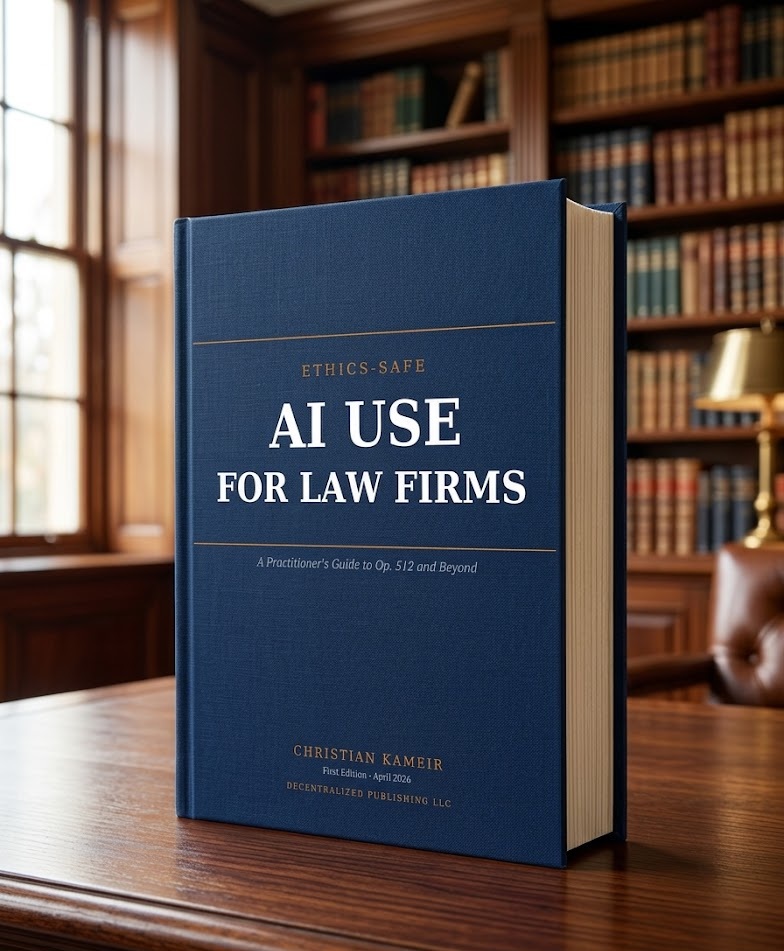
Ethics Safe AI Use for Law Firms
- 01
The Sanctions Record
What Mata, Park v. Kim, and the growing federal docket of AI sanctions orders mean for a PI firm filing in N.D. Cal., C.D. Cal., or any federal district court. What courts are actually requiring. What the sanctions in each case cost — in dollars, fees, and reputation. See the Mata Protocol â
- 02
ABA Formal Opinion 512 — What It Requires
The Opinion broken down into 12 specific obligations. Which apply to you on day one. Which require a written policy. Which require client disclosure. Which can expose a supervising partner to personal liability. Read the full breakdown â
- 03
The Intake Workflow
Where AI enters your intake process — chatbots, call screening, intake forms, conflict checks. Where it creates UPL exposure. What to allow, what to prohibit, and what your intake protocol must say in writing.
- 04
Demand Letters
The highest-volume AI use case in a PI firm. Where hallucinated medical facts, wrong statute of limitations calculations, and unverified treatment costs appear. The pre-send review checklist that catches them.
- 05
Pleadings and Discovery
Citation verification protocols. FRCP 11 pre-signature requirements. AI disclosure language for N.D. Cal. and C.D. Cal. filings. The discovery certification problem when AI drafts responses.
- 06
Medical Records and PHI
HIPAA, CMIA, and the BAA requirement most firms don't know about. Why the free tier of any AI tool is off-limits for medical record work. The PHI handling policy and vendor checklist.
- 07
Client Communication
Where AI-drafted client letters create confidentiality exposure. What the prompt-hygiene rule means in practice. The staff training requirement that ABA Op. 512 implies.
- 08
Advertising and Intake Marketing
CA Rule 7.1 and B&P § 6157 applied to AI-generated ad copy, intake chatbots, and landing pages. Why AI-written testimonials are a bar complaint waiting to happen. The advertising copy review checklist.
- 09
The Audit Scoring System
The same 47-point Red/Yellow/Green audit checklist offered as the free download — in expanded form, with scoring guidance, remediation steps, and the policy document each Yellow and Red item requires.
- 10
Building Your Firm's AI Governance Policy
A modular policy template covering all eight risk areas. Instructions for adapting it to your firm's practice areas, court jurisdictions, and staff structure. The annual review cadence.
From the playbook
The judicial record
From Mata v. Avianca (S.D.N.Y. 2023) to Wadsworth v. Walmart (N.D. Ala. 2025) to Johnson v. Dunn (5th Cir. 2025), the judicial response has moved in one direction: expanding scope, increasing sanctions, naming supervising partners — not just the attorneys who filed.
More than 500 cases involving lawyer AI misconduct had been reported in U.S. courts as of early 2026. Every one has a fact in common: no documented verification process was in place when the error occurred.
"'The AI produced it' is not a defense; it is the question."
— Ch. 8, p. 37
The verification protocol
The Mata Protocol — built into every AI-assisted filing: demand letters, pleadings, discovery responses, and briefs.
- Identify every citation as AI-generated.
- Database check — search the exact citation in Westlaw or Lexis.
- Read the source — confirm it stands for what the document says.
- Currency check — confirm it has not been overruled or limited.
- Quotation accuracy — verify any attributed quote appears in the opinion.
- Sign-off — the reviewing attorney signs the checklist before filing.
"The first draft is a starting point, not a final document."
— Ch. 16, p. 77
The advertising rule
CA Rule 7.1 and B&P § 6157 apply to AI-generated copy the same way they apply to any other advertising. An intake chatbot that answers prospective-client questions about case value without attorney review is a bar complaint waiting to happen. AI-generated client testimonials require the same signed release as any other testimonial.
Chapter 10 maps every qualitative marketing claim — superlatives, outcome implications, testimonial-style language — through a three-part scrutiny test: substantiation, implied-claim audit, and currency.
"Marketing copy is the firm's representation, indexed and timestamped."
— Ch. 10, p. 48
What comes with it
The Playbook
Ethics Safe AI Use for Law Firms — PDF + EPUB, immediately downloadable.
The Clause Library
Ready-to-use disclosure language for federal court filings in N.D. Cal. and C.D. Cal., client engagement letters, staff AI-use policies, and vendor agreements. Copy, adapt, use.
The 47-Point AI Audit Checklist
Red/Yellow/Green scoring across six practice areas: intake, demand letters, pleadings, discovery, medical records, and advertising. Print it. Run it with your ops manager.
12-Month Updates
The sanctions record is growing. Federal standing orders are multiplying. CA ethics opinions are coming. Every significant development affecting PI firms in California gets added to your copy — at no additional charge — for twelve months from purchase.
Pricing
Single User
$49
One attorney or one staff member. Full playbook + clause library + checklist + 12-month updates.
Get the PlaybookMost common for PI firms
Firm License — Up to 10 Attorneys
$199
Full firm access. Share with every attorney, paralegal, and case manager. One purchase, full team coverage.
Get the Firm LicenseFirm License — Up to 25 Attorneys
$499
For growing firms. Includes everything above plus priority access to Christian for questions during the first 90 days.
Get the 25-Attorney LicenseEnterprise (25+ attorneys or multi-location firms): Book a call to discuss a custom governance policy build and firm-wide training.
Work directly with Christian
60-Minute AI Risk Audit — $750
A review of your firm's current AI use across intake, drafting, discovery, and advertising — with a written gap analysis and the specific protocols to address your highest-priority exposures.
Book a callQuestions
- Is this a CLE?
- No. This is a practice management playbook, not a CLE course. Some bar associations may grant self-study credit — check with your state bar. It is not submitted or accredited as CLE.
- Does this cover my state's rules?
- Chapters 1–8 cover ABA Model Rules, ABA Formal Opinion 512, and federal court requirements — which apply in every jurisdiction. Chapters 5 and 8 include California-specific rules (N.D. Cal./C.D. Cal. AI standing orders, CA Rule 7.1–7.3, CA B&P § 6157). If you practice outside California, the federal and ABA content applies to you; the CA-specific sections provide a useful model even if your state rules differ.
- My firm is in another state. Is this useful to me?
- Yes. The sanctions exposure from Mata, Park v. Kim, and the growing federal docket of AI orders applies nationwide. ABA Formal Opinion 512 applies to every ABA member. The protocols, checklists, and clause library are designed to be adapted to any jurisdiction.
- Will this keep me out of trouble with my malpractice carrier?
- It is designed to help you build the documented AI policy that carriers are increasingly requiring. It does not guarantee any specific outcome with any carrier. Implement the protocols and disclose your policy proactively at renewal.
- What if the rules change after I buy?
- That is why 12-month updates are included. When a new sanctions order drops, a new federal standing order issues, or California issues a new ethics opinion affecting PI firms, the relevant section is updated and you receive the revised version.
- Can I share this with my whole firm?
- The $49 single-user license is for one person. The $199 firm license covers up to 10 attorneys and all staff. The $499 license covers up to 25. For firms larger than 25, or for multi-office arrangements, book a call to discuss enterprise options.
- I'm a malpractice carrier or bar association — can we license this?
- Yes. Book a call to discuss affinity partnership, bulk licensing, or co-branded distribution.
Your next AI error doesn't have to cost you a fee.
The protocols exist. The disclosure language exists. The checklist exists. You just need them in one place, adapted for how a PI firm actually runs.
Informational only. Not legal advice. Ethics rules vary by jurisdiction.